Skip to content

Seller guide

Selling Off-Grid Land Without Utilities

Updated November 21, 2026

Explore Selling Options
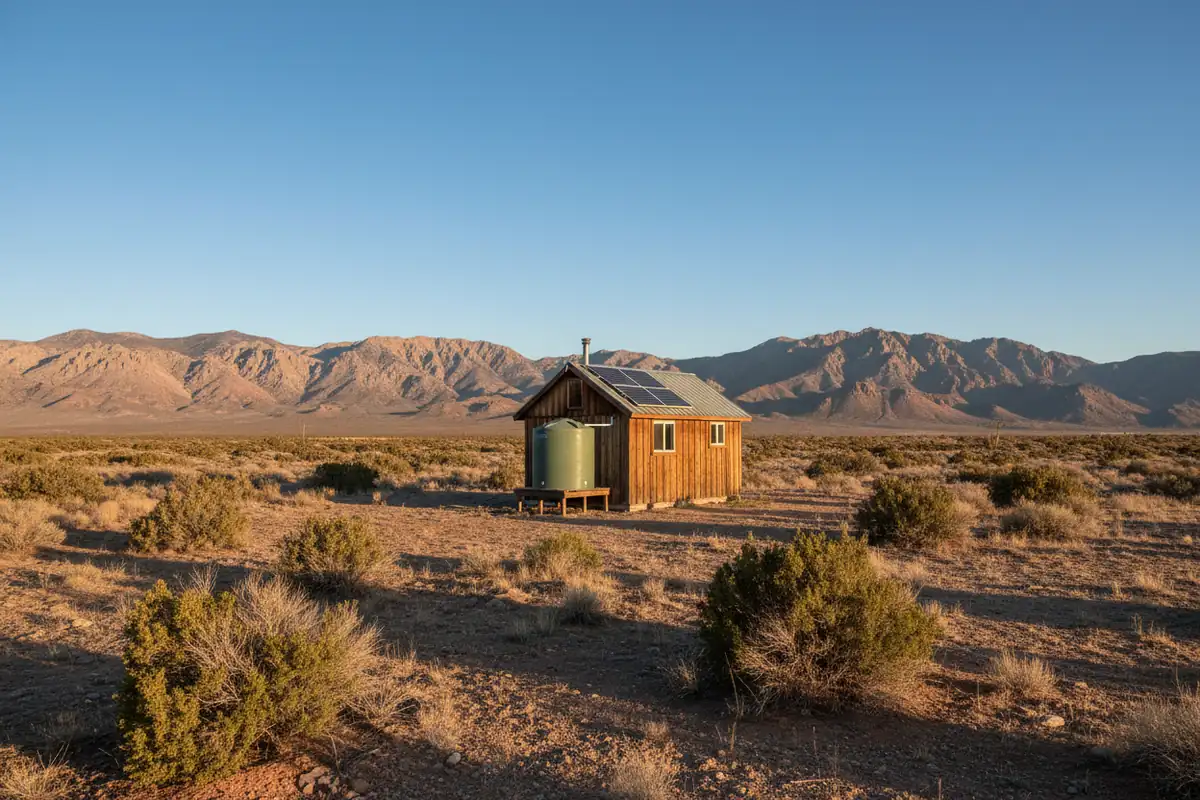
A remote cabin with solar panels and a water tank on high desert land.
Immediate answer

How California off-grid land sells: well completion reports, the State Water Board's septic policy, who may design a septic system, and Civil Code section 1001.

On this page
  1. What Off-Grid Land Means for an Owner Who Wants to Sell
  2. Who This Affects: Owners of Rural, Recreational, and Vacant Land
  3. Private Wells: Drilling Records and What a Buyer Will Check
  4. Septic Systems: The State's Onsite Wastewater Policy and Who May Design One
  5. Easements for Utility Service: What California Civil Code Section 1001 Provides
  6. Disclosures a Seller Owes When the Land Has No Utility Service
  7. Options and Trade-offs: How Buyers Value Off-Grid Land
  8. Mistakes to Avoid When Selling Off-Grid Land in California
  9. What to Do Next
  10. Frequently asked questions
  11. Sources

California land without power, public water or sewer can be sold as it is. A buyer will ask three things: where the water comes from, how wastewater would be handled, and whether utility service could reach the parcel. The records an owner holds on each of those points shape how the sale goes.

If you own a rural, vacant or recreational parcel with no grid power, no water main and no sewer line, you may be wondering whether that missing service is a problem and what a buyer will want to see. This guide walks through those questions: private wells and their drilling records, septic systems under the State Water Board's policy, who may design a septic system, and an owner's right to an easement for utility service. How these rules apply to a particular parcel depends on its facts and the law that governs it.

What Off-Grid Land Means for an Owner Who Wants to Sell

"Off-grid" describes a parcel that has no connection to a utility's electric lines, a public water system or a municipal sewer. Whatever the land has for power, water or wastewater, it has on its own, or it has nothing at all.

The answers to a buyer's three questions decide what the buyer can build, how a lender sees the land, and which county permits the buyer would need. California counties differ in what they require before a parcel with a private well or a septic system can be built on. The county planning department and the county environmental health department hold those rules for a given parcel.

Because a buyer will look into each of these points, the records you already hold carry real weight in the sale.

Who This Affects: Owners of Rural, Recreational, and Vacant Land

Off-grid conditions are common on vacant rural land, farmland, ranch land, timberland, recreational parcels, and remote desert or mountain lots. Many parcels in unincorporated county areas have never had utility service and are bought and sold that way as a matter of routine.

There is a difference between land that never had service and land that once did. A parcel that was never connected is a known quantity, and a buyer prices in the work of adding service. A parcel that once had service, with a disconnected meter, an abandoned well or an old septic tank, raises separate questions: what is still on the ground, what condition it is in, and whether the county has records of it. Buyers treat these two kinds of parcels differently.

On either kind of parcel, the absence of utilities is a feature of the land to describe accurately, not a defect to hide. Your part is to document what exists on the parcel. Installing what does not exist is not required of you.

Private Wells: Drilling Records and What a Buyer Will Check

A private well is a well drilled to supply water to one parcel or household, with no connection to a public water system. The U.S. EPA's Private Drinking Water Wells page says that private well owners are responsible for delivering safe drinking water to their households. It also says the quality and safety of private well water are not regulated by the federal government under the Safe Drinking Water Act, nor by most state governments and laws. In practice, a buyer relies on the well's own records and test results rather than on any agency's oversight.

The California State Water Resources Control Board's GAMA - Domestic Well Owners page says it is the responsibility of the well owner to make sure domestic well water is safe. The page offers a guide for domestic well owners, information on testing well water, including whom to contact and which chemicals to test for, and a step-by-step checklist for evaluating water quality. For well drilling records, called well completion reports, the same page points to the Department of Water Resources' DWR Well Completion Reports site. That site has a WCR Map Application for locating wells and their reports, and instructions for requesting a report that does not appear on the map.

An owner who can produce the well's completion report and recent water test results gives a buyer a much clearer picture than an owner who cannot.

County well rules and groundwater questions

Well permitting is handled locally, and, as with septic systems, what one county requires for a well can differ from what another requires. Details such as where a well may sit on a parcel or how it must be built are set at the county level, so the county environmental health department is the office that can say what applies to a particular well or a proposed new one.

A buyer of a well-dependent parcel may also ask about the groundwater supply itself, including whether the parcel lies in an area where groundwater use is subject to state or local management, such as under California's Sustainable Groundwater Management Act. That question, like water rights generally, is separate from the well's own records. This guide does not address either subject in detail, and an attorney or the county can explain how they apply to a given parcel.

Septic Systems: The State's Onsite Wastewater Policy and Who May Design One

An onsite wastewater treatment system, or OWTS, treats and disperses wastewater on the parcel itself, with no connection to a sewer. It is usually a septic tank and a leach field.

The State Water Board's Onsite Wastewater Treatment Systems (OWTS) Policy page says the Board adopted the Water Quality Control Policy for Siting, Design, Operation and Maintenance of Onsite Wastewater Treatment Systems in June 2012. The same page says the policy authorizes local agencies, such as county environmental health departments, to issue OWTS permits, and that their permitting must be consistent with the policy. For a seller, this means the county environmental health department holds any permit for an existing system and knows what a new one would require.

Who may design the system is a matter of statute. Health and Safety Code section 106620 provides that, except for the design of onsite septic systems, nothing in its article authorizes registered environmental health professionals of the kind it names to design any of the fixed works defined in a cited Business and Professions Code section. Put simply, septic design is the one such fixed work the statute leaves open to them. That is why a buyer or a county will often want to know who designed an existing system and whether it was permitted.

A buyer's inspector will also look at how well the system has been maintained. The U.S. EPA's How to Care for Your Septic System page says the average household system should be inspected at least every three years by a septic service professional. It says household tanks are typically pumped every three to five years, and that alternative systems with pumps or mechanical parts are generally inspected once a year. The EPA page also advises owners to keep maintenance records. Those service reports are the evidence a buyer's inspector will ask to see.

Easements for Utility Service: What California Civil Code Section 1001 Provides

Sometimes the only practical way to bring a power line or water pipe to a parcel is across a neighbor's land. The legal right to do that is called an easement. When the right belongs to your parcel itself, rather than to you personally, it is "appurtenant," which simply means it stays with the land and passes to the next owner when the parcel is sold.

Civil Code section 1001 lets an owner take such an easement through eminent domain, which is the power to acquire property rights by court process, with compensation, even if the other owner does not agree. Here is the text of the law:

"(a) As used in this section, 'utility service' means water, gas, electric, drainage, sewer, or telephone service. (b) Any owner of real property may acquire by eminent domain an appurtenant easement to provide utility service to the owner's property. (c) In lieu of the requirements of Section 1240.030 of the Code of Civil Procedure, the power of eminent domain may be exercised to acquire an appurtenant easement under this section only if all of the following are established: (1) There is a great necessity for the taking. (2) The location of the easement affords the most reasonable service to the property to which it is appurtenant, consistent with the least damage to the burdened property. (3) The hardship to the owner of the appurtenant property, if the taking is not permitted, clearly outweighs any hardship to the owner of the burdened property."

So when a buyer asks whether an unserved parcel could ever be connected, this statute is part of the answer, but all three conditions have to be established. Whether an easement already exists, or could be acquired, depends on where the parcel sits, which parcels surround it, and the service territory of the utility involved. A title search and a real estate attorney are the resources for that question, and a contested easement is a matter for an attorney.

Disclosures a Seller Owes When the Land Has No Utility Service

The facts a buyer would want to know about off-grid land are easy to list: that utility connections are absent, the condition of any well, and the status of any septic system. Facts like these, which bear on a parcel's value or desirability, are the core of what California sellers disclose.

Which disclosure forms apply to a vacant land sale is a separate question. The forms used for most home sales may not fit raw land in the same way, and a land sale may involve different or additional requirements. Natural hazards form their own category. Fire hazard severity zones, flood zones and earthquake fault zones are among the conditions California's hazard disclosure rules address. A real estate attorney or the seller's real estate agent can say which forms apply to a specific parcel.

Documenting the water source, the wastewater system and the utility access, or the absence of each, gives the buyer what is needed to go forward and reduces the chance of a dispute after closing.

Options and Trade-offs: How Buyers Value Off-Grid Land

Beyond the utility questions, a buyer weighs the parcel's legal and physical access and its zoning and permitted uses. Each gap becomes work or risk that the buyer has to account for.

Listing with a real estate agent puts the parcel in front of the open market. That route usually involves more preparation and showings, and the sale can depend on a buyer's loan, which may be harder to get for land without utilities.

Selling the parcel as it is, to a buyer who pays cash and takes it in its present condition, works differently. That kind of offer is often lower than an open-market price, because the buyer takes on the unknowns, the risk and the cost of reselling. In exchange, the seller usually has less preparation, fewer showings and less dependence on a buyer's financing. The seller's disclosure duties are the same either way.

Carrying back financing means the seller acts as the lender for part of the price. It can widen the pool of buyers, but the seller is paid over time and takes on the risk that the buyer does not pay.

One way to compare these routes is to set written offers side by side by their estimated net proceeds: the price less commissions, repairs, carrying costs, loan payoffs and closing costs. That comparison shows which route fits a given owner.

Mistakes to Avoid When Selling Off-Grid Land in California

Missing well records are a common stumbling block. A buyer's lender or inspector will ask for the completion report and water test results, and an owner who cannot produce them can face delays or a renegotiated price.

Assuming the septic system is permitted is another. Older systems on rural parcels may have been installed without a permit, or may be near the end of their useful life. A buyer's due diligence will turn this up, so an owner who learns the system's status from the county before listing is in a better position.

Treating county rules as uniform causes trouble too. Each of California's counties runs its own environmental health and building departments, so a neighbor's experience across a county line says little about your parcel.

Overlooking the easement question is the last common mistake. A parcel with no recorded easement for access or utilities can be harder to finance or develop, and a title search before listing brings the issue to light early.

What to Do Next

Each document a buyer will ask for has a known home. The well completion report is searchable through the Department of Water Resources' WCR Map Application, which the GAMA page links. Septic permit and inspection records sit with the county environmental health department. Recorded easements are at the county recorder's office, and the zoning designation is with the county planning department.

Each part of the sale also has a matching professional. A real estate attorney handles title and disclosure questions. A registered environmental health professional handles septic design, as Health and Safety Code section 106620 allows. A well drilling contractor or a water testing laboratory handles well testing.

For many owners, gathering those county and state records is the practical first step before talking with buyers.

Seller questionnaire

Curious what your options are? Start with six short questions.

Answer six short questions about your land — type, acreage, location, access, timeline — to explore your selling options.

Seller guides

  1. Understand value

    Access, water, soils, zoning and entitlements shape what buyers will pay.

  2. Match the right buyer

    A ranch buyer and a homebuilder value the same acres differently.

  3. Local context

    County rules matter. See our California and San Diego County guides.

Explore Selling Options
What type of land are you selling?
Approximately how many acres?

Where is the property?

How is the property accessed?
Utilities available (select all that apply)
When would you like to sell?

How can we reach you?

See our Privacy Policy and Terms.

Testimonials

The parcel had access questions and no utilities. I appreciated an offer that accounted for that.

M.K., Minneapolis, MN

Explore your selling options

Answer a few questions about your parcel.

Start the questionnaire

Frequently asked questions

What does a buyer check when there is no public water on a parcel?

A buyer looks for a private well and its paperwork. Where no well exists, the question changes to whether one could be drilled and permitted, which is a question for the county environmental health department rather than for the seller's records.

Who may design a septic system in California?

Health and Safety Code section 106620 allows registered environmental health professionals to design onsite septic systems. For a seller, the practical point is less who could design a new system and more whether the county has a permit on file for the existing one.

Can an owner get utility service to a parcel that has none?

Civil Code section 1001 gives an owner a route to an easement through eminent domain, but only where all three of its conditions are established. Whether that route is realistic depends on the parcel's location and its neighbors. A title search and a real estate attorney can address a specific parcel.

What disclosures does a seller owe when land has no utilities?

Buyers expect to hear plainly that service is absent, along with what is known about any well or septic system. Natural hazard zones are handled separately, and the forms for raw land may differ from those for a home sale, so a real estate attorney or agent can confirm the set that applies.

Is it legal to go off-grid in California?

Using land without utility connections is governed by county zoning, building and environmental health rules, and those rules vary from county to county. Wells, septic systems and structures each involve county permits. The county planning and environmental health departments can say what applies to a specific parcel.

What are the main things that affect the value of off-grid land?

The main factors are access, zoning, the presence and condition of a well and a septic system, and how practical it would be to add utility service. Size and location matter as well. An appraiser can give a value for a particular parcel.

Where can I find well records for a California parcel?

The Department of Water Resources' WCR Map Application, linked from the State Water Board's GAMA page, is the starting point. If a report is not on the map, the same site explains how to submit a request, which can be worth doing before a buyer asks.

Sources

Statutes, regulations and court sources

  1. 01Civil Code section 1001 (California Legislative Information) · California Legislative Information
  2. 02Health and Safety Code section 106620 (California Legislative Information) · California Legislative Information

Other sources

  1. 03California State Water Resources Control Board: Onsite Wastewater Treatment Systems (OWTS) Policy · waterboards.ca.gov
  2. 04California State Water Resources Control Board: GAMA - Domestic Well Owners · waterboards.ca.gov
  3. 05U.S. EPA: Private Drinking Water Wells · U.S. Environmental Protection Agency
  4. 06U.S. EPA: How to Care for Your Septic System · U.S. Environmental Protection Agency