Skip to content

Sell Development & Entitled Land

Updated November 21, 2026

Explore Selling Options
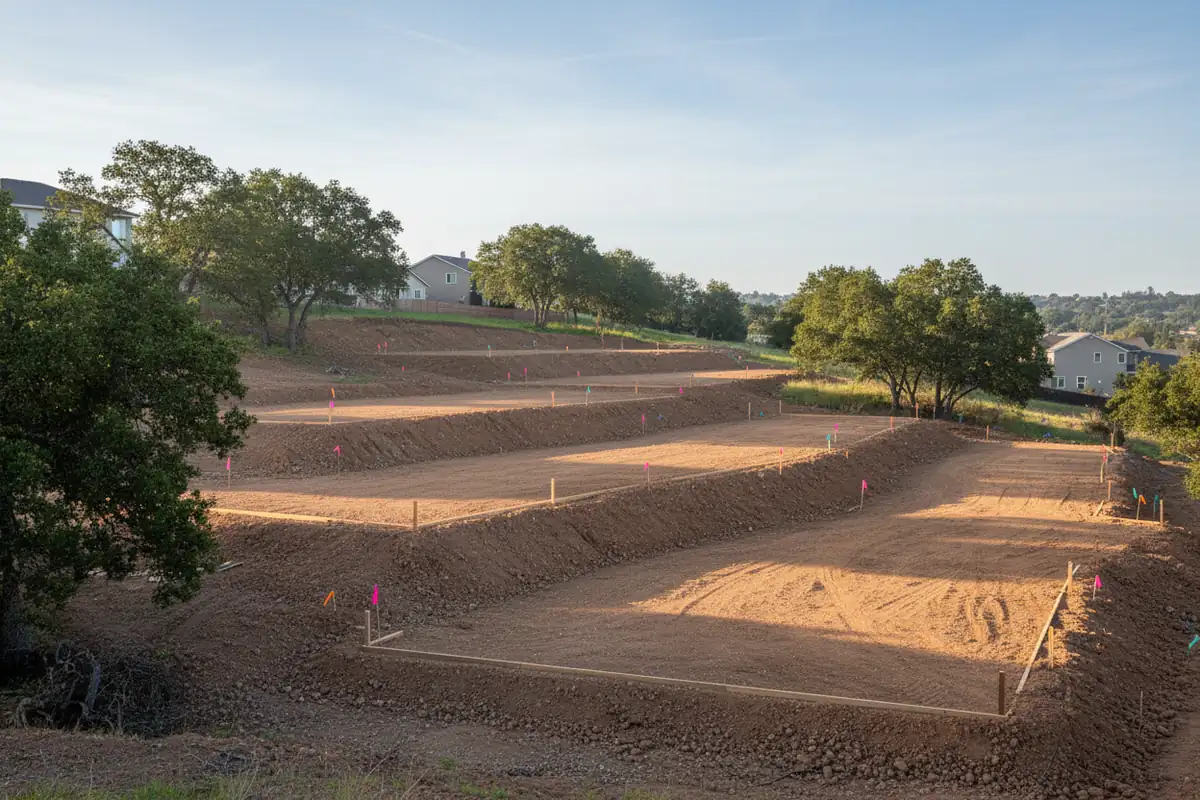
Graded building pads stepping up a hillside, land prepared for future homes.
Immediate answer

Selling development land in California: when a recorded map is needed before sale, when a DRE public report applies, and who needs a real estate license to sell for you.

On this page
  1. Key Takeaways
  2. When This Option Fits Your Parcel
  3. How It Works, Step by Step, for an Owner Selling Development Land
  4. Costs, Timing and Trade-offs
  5. Options to Compare
  6. What to Have Ready Before You Offer the Land
  7. Local Context
  8. Frequently asked questions
  9. Sources

Development land in California can be sold as the parcel it is today, or divided first and sold as lots. If the sale divides the land, the map the law requires generally has to be recorded before any lot is sold. Land divided into five or more lots also needs a Department of Real Estate public report before it is offered.

You own land that someone could build on. It might be an infill lot in town, acreage at the edge of a growing area, or a parcel that already carries approvals. Now you are deciding whether to sell it as it stands or to do some of the groundwork first. Buyers look first at the parcel itself: how it is reached, how it is zoned, what water and utilities can serve it, and whether it is a legal lot that can be conveyed. This page covers the California rules that decide how development land is divided and offered, the sale paths an owner can compare, and the records that answer a buyer's first questions.

Key Takeaways

  • Selling part of a parcel is a division. Under Government Code section 66424, splitting land for sale, lease or financing counts as a subdivision.
  • The map generally comes first. Government Code section 66499.30 ties a sale to recording the required map, though a contract can be signed early if it waits on the map.
  • Five lots brings in the state. Business and Professions Code section 11000 sets the five-lot line, and section 11010 adds a Department of Real Estate filing before lots are offered.
  • A paid helper needs a license. Business and Professions Code sections 10130 and 10131 cover anyone paid to sell or negotiate for you.

How each rule applies depends on the parcel's facts and on the local ordinance that governs it. The steps below walk through the details.

When This Option Fits Your Parcel

"Entitled land" is land that has received government approvals that allow a specific type or density of development. Those approvals can include a zoning classification, a general plan designation, or a discretionary permit such as a conditional use permit, a variance or a specific plan approval. Raw land with development potential has not yet received those approvals, so a buyer would have to seek them.

A builder or developer looking at a site usually checks:

  • legal access, and any easements that cross the land or serve it
  • the zoning and general plan designation
  • utility capacity for sewer, electricity and gas
  • water availability, which can decide whether a project is feasible at all
  • any recorded map, lot-line adjustment or approval already in place

Two California frameworks shape how this land changes hands. The Subdivision Map Act governs how land is divided and what map is required. It works through city and county ordinances and the county recorder. The Subdivided Lands Act governs how land divided into five or more lots is offered to the public, through the Department of Real Estate.

Selling a single existing parcel with development potential is one path. In that case the buyer usually takes on the map and approval work. Dividing the land and selling the resulting lots is another path, and it brings the map requirement and, at five or more lots, the public report into play. Which path fits depends on whether the parcel is already a legal lot, what its zoning allows, and how much of the approval work you want to take on before a sale.

How It Works, Step by Step, for an Owner Selling Development Land

The order below follows the statutes. Your local ordinance adds its own details at each stage.

Step 1: Confirm the parcel's status. The starting question is simple: can the land be sold as one piece as it is, or would the sale cut it into pieces? The legal test is in Government Code section 66424, which defines a subdivision as the division of improved or unimproved land for the purpose of sale, lease or financing, whether immediate or future. The definition looks to how the land is shown on the latest equalized county assessment roll, and pieces separated only by roads, utility easements or railroad rights-of-way still count as contiguous. It also includes condominium projects, community apartment projects, and the conversion of five or more existing dwelling units to a stock cooperative. A plan to sell off a portion is, in legal terms, a plan to subdivide.

Step 2: Record the required map first. In plain terms, the map is what makes a new lot legal to sell. Government Code section 66499.30 bars selling, leasing or financing a parcel, or starting construction of a building for sale, lease or financing on it (model homes are excepted), until the required final map or parcel map is filed for record by the recorder of the county where any part of the subdivision lies. Whether a division needs a final map or a parcel map is set by the Subdivision Map Act and the local ordinance. Conveyances by lot or block number also wait for that recording. There are two exceptions. The rule does not apply to parcels sold in compliance with, or exempt from, the subdivision laws in effect when the subdivision was established. It also does not bar an offer or contract that is expressly conditioned on the map's approval and filing. Negotiations can start before recording; the closing is what waits.

Step 3: Count the lots. The lot count matters because it decides whether a second, state-level process applies. Under Business and Professions Code section 11000, land divided or proposed to be divided into five or more lots for sale, lease or financing is subdivided land. There is an exception for lots of not less than 160 acres that are designated by government survey and appear that way on the county's current assessment roll. That exception does not apply when the land is divided for sale for oil and gas purposes. Four lots and five lots can lead to quite different sale processes.

Step 4: File for a public report. A public report is the Department of Real Estate's disclosure document for buyers of subdivided lands, and the filing is how the Department learns what it will describe to them. Business and Professions Code section 11010 generally requires a notice of intention and a completed questionnaire to be filed with the Department before the land is offered for sale or lease. The section allows exceptions provided elsewhere in the same chapter, so whether a given offering must file depends on its facts. The notice covers, among other items, the owner and subdivider, the legal description, the condition of title and all encumbrances, the terms of sale, provisions for utilities including water and sewerage, any use restrictions, and certain notices, such as those about nearby airports and nearby farmland. The commissioner may waive the questionnaire in some cases. The filing becomes a full written account of the land and its terms.

Step 5: Know who may sell for you. The license rule turns on whether someone is paid to act on your behalf. Business and Professions Code section 10131 defines a real estate broker as a person who, for compensation or the expectation of it, does certain acts for another, including selling or offering to sell, soliciting buyers or sellers, obtaining listings, or negotiating the purchase, sale or exchange of real property. Business and Professions Code section 10130 makes it unlawful to act as a broker or a salesperson without first obtaining a real estate license from the Department. Checking a helper's license status is part of choosing who markets the land.

Costs, Timing and Trade-offs

What a sale costs comes down to how much work remains and who does it. The main factors are:

  • approvals already in place versus approvals still needed
  • whether a map must be recorded before the sale
  • whether a public report is required
  • how a real estate agent's compensation is set
  • carrying costs, such as property taxes, during any preparation
  • closing costs

Timing follows the same factors. A required map generally holds the sale until the county recorder files it, unless the contract is expressly conditioned on the map. For subdivided land, offering it generally waits on the public report application. If the parcel already holds its approvals, those steps may already be done. None of these steps has a fixed length that applies to every parcel, so this page states no time figures.

Entitled and unentitled land trade differently. With an entitled parcel, the buyer takes on less approval risk, so it typically attracts a different price and a different set of buyers than raw land does. Selling raw land moves that risk, and the work that goes with it, to the buyer, and the price usually reflects that. Getting approvals before a sale costs the owner time and money, and it does not promise any result.

No kind of buyer changes the rules. A direct sale or a cash sale is still subject to the Subdivision Map Act and the Subdivided Lands Act, and the seller's disclosure duties stay the same.

Options to Compare

Listing with a real estate agent. An agent brings the land to the open market and negotiates for you. Compensation is agreed in a listing contract. Open exposure can reach builders who value the site's potential, but a listing usually means preparation, inquiries and buyer contingencies.

Selling directly to a developer or builder. A builder may already understand the site and the local approval process, and negotiation happens between the two of you. Without an agent on your side, you set the terms and review the contract yourself or with an attorney.

Selling to a cash buyer who takes the land as it is. A direct offer is often lower than an open-market sale price. The buyer takes on the approval risk, the cost of any required map work, and the cost of reselling. In exchange, you do less preparation and face fewer contingencies, such as those tied to a buyer's loan or to approvals. The map, public report and disclosure rules apply to this sale like any other.

Carrying back financing. Here you act as the lender. The buyer pays part of the price over time, and the loan is secured by the land. Section 66499.30 treats financing a parcel the same way it treats a sale, so the map rule still applies. A tax professional and an attorney usually review how the note and deed of trust are structured.

Owners often compare written offers by estimated net proceeds: the price less commissions, approval costs, carrying costs, loan payoffs and closing costs.

What to Have Ready Before You Offer the Land

A buyer's first questions are about the parcel itself, and these records answer most of them:

  • Legal description and assessor's parcel number. These identify exactly what is being sold.
  • Recorded maps. This means any subdivision map, parcel map or lot-line adjustment. They show whether the land can be conveyed as it is.
  • Existing approvals. These include the general plan designation, the zoning classification, and any conditional use permit, variance or specific plan approval.
  • Utility information. This covers whatever records exist on water, sewer, electricity and gas service. Water rights are a separate subject, and they can affect what a buyer is able to build.
  • Title report. A preliminary title report shows easements, encumbrances and recorded restrictions, including how the parcel is reached.
  • Hazard and disclosure information. California requires certain disclosures on land sales. Which ones apply depends on the parcel's location and facts, and an attorney can confirm them. For subdivided lands, section 11010 itself requires certain notices, including notices about nearby airports and nearby farmland.
  • Williamson Act status. A Williamson Act contract is an agreement with the county that keeps land in agricultural use in exchange for property tax treatment. It is recorded against the parcel, and it can limit development.

Local Context

California's counties and incorporated cities each keep their own general plan and zoning ordinance, so what can be built on a parcel in one jurisdiction may not be allowed in the next. The Subdivision Map Act also works through local ordinances, so the map a division needs depends partly on where the land sits.

The California Environmental Quality Act, known as CEQA, is the state's environmental review framework. It requires public agencies to study the environmental effects of most development projects they approve, and a buyer will ask how that review might apply to the site. Housing Element law requires cities and counties to plan for their share of regional housing need, and it limits how they can treat some housing proposals. A buyer planning homes will look at both.

Location shapes value. An urban infill site may already have utilities and compatible zoning. A suburban fringe parcel may still need annexation, service extensions or new approvals. Rural agricultural land may face a Williamson Act contract and few utilities. Each situation changes what a buyer will pay and how much approval work remains. For land under a Williamson Act contract, its status, including any nonrenewal or cancellation, is worth confirming before the parcel is offered.

A common next step for owners is to find the parcel's recorded deed and any recorded map at the county recorder, look up its zoning and general plan designation with the city or county planning department, and note any questions about water or access to raise with a buyer or an attorney.

Seller questionnaire

Curious what your options are? Start with six short questions.

Answer six short questions about your land — type, acreage, location, access, timeline — to explore your selling options.

Seller guides

  1. Understand value

    Access, water, soils, zoning and entitlements shape what buyers will pay.

  2. Match the right buyer

    A ranch buyer and a homebuilder value the same acres differently.

  3. Local context

    County rules matter. See our California and San Diego County guides.

Explore Selling Options
What type of land are you selling?
Approximately how many acres?

Where is the property?

How is the property accessed?
Utilities available (select all that apply)
When would you like to sell?

How can we reach you?

See our Privacy Policy and Terms.

Testimonials

The parcel had access questions and no utilities. I appreciated an offer that accounted for that.

M.K., Minneapolis, MN

Explore your selling options

Answer a few questions about your parcel.

Start the questionnaire

Frequently asked questions

Are taxes owed on the sale of vacant land in California?

A sale of vacant land can produce a taxable gain. Gain is generally the difference between the sale price and your adjusted basis, which is roughly what you paid plus certain costs. How it is treated depends on how long you held the land and how you used it. A CPA, an enrolled agent or a tax attorney can review your situation.

Can you sell development land in California without a real estate license?

Selling your own land does not make you a broker. Under section 10131, a broker acts for another person for compensation. If you pay someone to market or negotiate the sale for you, section 10130 requires that person to hold a real estate license. The Department of Real Estate lists unlicensed activity among the most common violations it acts against.

What is the Subdivision Map Act and how does it affect a land sale?

The Subdivision Map Act is the California law that controls how land is divided. In practice, it means a lot split off for sale generally cannot close until the required map is recorded. A contract expressly conditioned on the map's approval and filing can be signed earlier.

What is a public report and when is one required before selling land?

A public report is the Department of Real Estate's disclosure document for buyers of subdivided lands. The application generally comes before offering five or more lots for sale or lease. Its contents give buyers a single account of title, utilities and use restrictions, and that account can make the lots easier for buyers to evaluate.

How much does it cost to sell development land in California?

The cost depends on how much work the sale still needs. The factors are map recording, a public report, any remaining approval work, an agent's compensation, carrying costs and closing costs. Filing fees are set by the agencies involved. An attorney and a real estate agent who know the parcel can give a cost picture based on its facts.

What disclosures does a seller of development land owe in California?

The disclosures owed depend on where the parcel is and what affects it. Hazards, zoning and recorded restrictions such as a Williamson Act contract all play a part. For subdivided lands, section 11010 also requires certain notices in the public report application. A real estate attorney can confirm the full list for a specific parcel.

What is entitled land and why does it matter to a buyer?

Entitled land already holds approvals that allow a specific type or density of development. Those approvals take much of the approval risk off a buyer's plate, so the parcel tends to attract buyers ready to build rather than buyers who plan to seek approvals themselves.

Does a Williamson Act contract affect the sale of agricultural land with development potential?

Yes. A Williamson Act contract restricts the land's use, and it is recorded against the parcel. A buyer planning to develop will want to know whether the contract is active, in nonrenewal or being cancelled. A real estate attorney can review how the contract affects a particular sale.