
Skip to content

Seller guide

Perc Tests and Selling Land

Updated November 21, 2026

Explore Selling Options
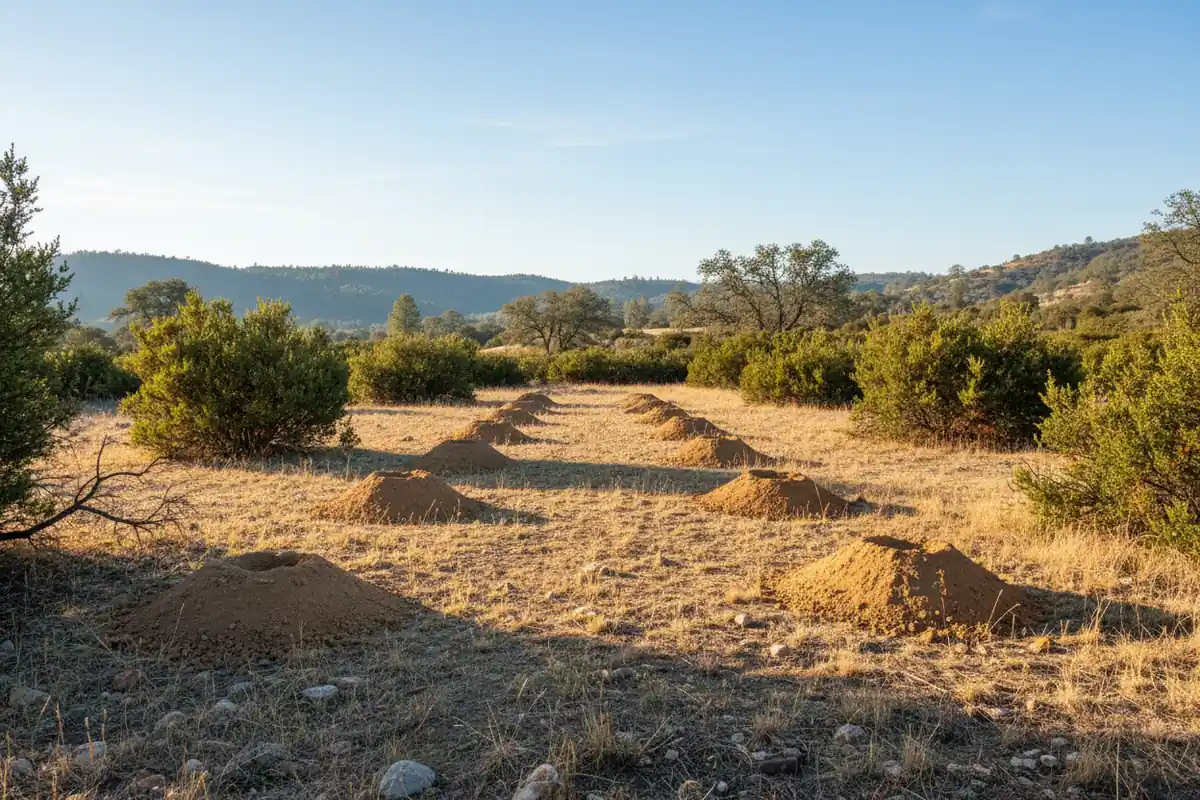
Small test holes dug in rural soil, where septic suitability gets measured.
Immediate answer

How a perc test shows whether California land can take a septic system, how counties use the data under the State Water Board's OWTS Policy, and which records buyers ask for.

On this page
  1. What a Perc Test Actually Measures
  2. What It Means for Owners Selling Land
  3. Who Orders a Perc Test and Who May Design a Septic System
  4. How California Counties Use Percolation Test Data
  5. Septic Records Buyers Ask For
  6. What Happens When a Perc Test Fails or Is Missing
  7. Common Misunderstandings
  8. Frequently asked questions
  9. Sources

If you are selling California land with no sewer connection, a perc test is how a buyer learns whether the soil can take a septic system. The test measures how fast water soaks into the ground. A county environmental health department uses that data, with soil and groundwater conditions, to decide whether a septic permit can be issued and which kind of system fits.

You may own a vacant lot, a stretch of ranch land or a rural parcel that has never had a house on it. Now a sale is coming, and a buyer, or the buyer's agent, will almost certainly ask the same question: has anyone tested the soil, and what did it show? The answer shapes who will want the parcel and what they can build on it. The sections below explain what the test measures, who controls the process in California, which records buyers look for, and what a failed or missing result means for a sale. How these rules apply to one parcel depends on its facts and on the county rules that govern it.

What a Perc Test Actually Measures

A percolation test, or perc test, is a field test of how quickly water drains through the soil on a particular spot of land. A hole is dug, water is added, and the drop in the water level is timed. The result is reported as a percolation rate.

The goal is a middle ground. Soil that drains at a steady, moderate pace can usually treat the liquid that leaves a septic tank. Soil that drains too slowly, such as dense clay, can stay saturated, and wastewater can then back up or surface. Soil that drains very quickly may pass wastewater down to groundwater before the soil has treated it.

A perc test is also only one piece of a larger site evaluation. The county looks at how deep the soil goes, the slope and the depth to groundwater. The County of San Diego's Frequently Asked Questions on Septic Systems page says that conventional septic systems "must have at least 5 feet of unsaturated soil depth for the soil to provide treatment." Under that page's rules, a good perc rate alone does not settle the question.

The test matters most on rural and undeveloped parcels that cannot connect to a public sewer, where a septic system is often the only way to serve a home. A workable result opens the door to a septic permit. A slow or failing result limits how the land can be used, at least with a conventional system.

What It Means for Owners Selling Land

Because a home site with no way to treat wastewater may not be buildable, septic feasibility tends to surface early in a buyer's due diligence, the period in a sale when the buyer investigates the property before committing. That makes the test's status less a technical detail than a factor in who the realistic buyers are.

In practice, most parcels fall into one of three situations. If a passing result and an approved design are already on file with the county environmental health department, a buyer has something concrete to rely on, though the buyer still checks whether that result fits the planned use. If no test is on record, the buyer has to guess or pay for testing during escrow; some buyers accept that uncertainty, and some move on to parcels where the question is already answered. And if the result was failed or marginal, the pool of buyers who need a conventional system shrinks, while buyers planning uses that need no septic system, or an alternative system, may remain.

Owners of land in hilly, high-groundwater or clay-heavy areas often find this question comes up before anything else in a sale.

Who Orders a Perc Test and Who May Design a Septic System

Septic permits in California are issued by local agencies, usually a county environmental health department, under a statewide policy. The State Water Resources Control Board's Onsite Wastewater Treatment Systems (OWTS) Policy page states that the policy "authorizes local agencies (e.g., county environmental health departments) to issue OWTS permits." OWTS is the state's term for a septic system and similar onsite treatment. The page adds that "Local agency permitting activities must be consistent with the requirements of the OWTS Policy."

Who arranges the test in a land sale depends on the sale contract. Sometimes the owner tests before listing. Sometimes the buyer tests during escrow with the owner's permission. Either way, the testing follows the county's own procedures. The County of San Diego's Septic Systems page lists "Percolation Test and Vertical Pit Capacity Test Procedures & Guidance" among its program materials.

California law speaks directly to who may design a septic system. Health and Safety Code section 106620 provides: "Except for the design of onsite septic systems, nothing in this article shall authorize registered environmental health" professionals "to design any of the fixed works" that another part of California law defines. Put plainly, a registered environmental health professional may design an onsite septic system, even though that article does not authorize such a professional to design those other fixed works.

The County of San Diego's FAQ page says civil engineers, registered geologists and registered environmental health professionals "are currently recognized to be qualified to design septic systems." Whoever does the design, a good result in the field becomes a usable permit only after the county reviews it.

How California Counties Use Percolation Test Data

The State Water Board adopted the OWTS Policy in June 2012, according to its OWTS Policy page. Counties apply the policy, and some adopt a local plan of their own. The County of San Diego's Septic Systems page explains that its Local Agency Management Program (LAMP) "provides alternative standards than those set by the State Water Resources Control Board's Onsite Wastewater Treatment System (OWTS) Policy and must still achieve the same water quality and public health protections." That page also says new and updated forms for its 2025 LAMP took effect February 1, 2025.

San Diego County offers a useful example of how a perc number turns into practical limits on a parcel. Its rules are local and are not statewide law, but they show why the test result matters beyond a simple pass or fail. According to the County's FAQ page:

  • For homes, "the size of the disposal field is a combination of percolation test data and the number of bedrooms within each dwelling unit."
  • For commercial designs, field size combines percolation data with "the peak daily sewage flows based on the type of usage and occupancy of the site."
  • Leach lines "can be installed anywhere in the county where the site meets design criteria." Vertical seepage pits are limited to coastal sedimentary basins where saltwater intrusion has degraded groundwater. Horizontal seepage pits are limited to sites with "deep, permeable soil, with uniform good percolation rates."
  • All designs must meet the Regional Water Quality Control Board's requirement of at least 5 feet between anticipated high groundwater and the bottom of the disposal system.

In other words, perc data affects how large a system must be and what kind it can be, and those details shape what a buyer can build. Other California counties apply the same state policy through their own procedures, so a parcel elsewhere follows that county's rules.

Septic Records Buyers Ask For

Much of what a buyer wants to see may already exist in a county file, even if the current owner has never looked. The County of San Diego's FAQ page says its Department of Environmental Health and Quality Land and Water Quality Division maintains "records of septic systems that have been installed since the late 1970's," filed "by the tax assessor parcel number." The assessor parcel number (APN) is the number the county assessor gives each parcel, and it appears on the property tax bill.

The requests tend to follow the parcel's history. A buyer of rural land commonly asks for:

  • Prior percolation test results on file for the parcel.
  • An approved septic design or permit, if one was ever issued.
  • Installation and permit history, showing whether a system was built and inspected.
  • Service records for any existing system, such as inspection and pumping reports.

The County of San Diego's Septic Systems page says its Land Use Program records, including septic systems, are in an online Document Library. If a record is not found online, the page says a request can go through its Public Records Request Center to the Food, Water and Housing Division.

For parcels that already have a system, the EPA's How to Care for Your Septic System page suggests keeping "the maintenance records on work performed on your septic system." It also says the provider "should note repairs completed and the tank condition in your system's service report."

Having these records in hand before a sale gives the owner a clearer picture and can cut down on back-and-forth once due diligence begins.

What Happens When a Perc Test Fails or Is Missing

A failed perc test can feel like a dead end, but it does not, by itself, bar a sale. Some buyers purchase land knowing a conventional septic system will not work, for uses that need no system or for a system of another type.

Alternative systems may help on some parcels. The County of San Diego's FAQ page says Supplemental Treatment Systems "offer higher treatment than a standard conventional system." It adds that they "can reduce the separation required between the treatment system and high groundwater to 2 feet." That page says the County's LAMP, adopted in August 2015, allows these systems "for the purposes of developing existing undeveloped lots and creating new lots with parcel and subdivision maps." The County's Septic Systems page says such systems "must include percolation testing and a design" from an OWTS professional. Whether an alternative system fits a given parcel is the county's decision.

An owner facing a missing or failed result generally has two paths, each with trade-offs:

PathWhat it offersWhat it costs the owner
Order a new evaluation before listingBuyers see a current answer; the owner learns the parcel's limits firstTime, testing and design costs, and a result the owner must then disclose
Sell with the current status disclosedNo pre-sale testing; buyers do their own investigationFewer buyers who need certainty, and more uncertainty in negotiations

Septic feasibility is the kind of fact a buyer treats as important when deciding whether to buy. Which septic facts a seller must disclose, and how, is a question a real estate attorney can answer for a particular sale.

Common Misunderstandings

Owners who have held land for years often carry assumptions about its septic status that no longer match the county's view. A few come up again and again.

One is treating an old result as settled. Records stay with the parcel, filed by APN, but whether an older test still supports a permit for a new plan depends on the county's current rules and the proposed use. San Diego County, for example, sizes residential systems partly by bedroom count, so a test done for a smaller home may not fit a larger one.

Another is confusing a perc test with a septic inspection. A perc test evaluates soil for a system that has not been built yet; an inspection checks a system that already exists. The EPA page says a household system "should be inspected at least every three years by a septic service professional," that household tanks "are typically pumped every three to five years," and that systems with mechanical parts are generally inspected once a year.

A third is overlooking the county file. Prior results, approved designs and permit history may already be on record, and buyers can find them too.

Finally, a single failure is not necessarily permanent. County programs change: San Diego County adopted a new LAMP in 2025 and allows alternative systems under conditions its pages describe. The county's records and a current site evaluation give a more accurate picture than a prior owner's recollection.

Seller questionnaire

Curious what your options are? Start with six short questions.

Answer six short questions about your land — type, acreage, location, access, timeline — to explore your selling options.

Seller guides

  1. Understand value

    Access, water, soils, zoning and entitlements shape what buyers will pay.

  2. Match the right buyer

    A ranch buyer and a homebuilder value the same acres differently.

  3. Local context

    County rules matter. See our California and San Diego County guides.

Explore Selling Options
What type of land are you selling?
Approximately how many acres?

Where is the property?

How is the property accessed?
Utilities available (select all that apply)
When would you like to sell?

How can we reach you?

See our Privacy Policy and Terms.

Testimonials

The parcel had access questions and no utilities. I appreciated an offer that accounted for that.

M.K., Minneapolis, MN

Explore your selling options

Answer a few questions about your parcel.

Start the questionnaire

Frequently asked questions

What would cause a perc test to fail?

Soil that holds water too long, such as dense clay, or groundwater that sits too close to the surface, can keep a site from meeting a county's criteria. In San Diego County, the County's FAQ page also ties approval to separation from high groundwater, not to drainage speed alone. The county's rules set the acceptable limits.

What is a good perc rate?

A good rate is one that falls inside the range the county accepts for the system type planned. Under San Diego County's FAQ page, the rate also affects how large the disposal field must be, so "good" depends on the planned home size as well as passing or failing.

How do you test a septic tank?

An existing tank is checked through inspection and pumping, not a perc test. The EPA page says a service provider inspects for leaks and examines the scum and sludge layers. It says pumping is due when, for example, sludge and scum make up more than 25 percent of the liquid depth.

How much does a perc test cost?

Cost varies by county, by parcel conditions and by how much evaluation the county requires. The County of San Diego's Septic Systems page says its fees are collected under the fee schedule in effect for the fiscal year in which services are provided. The county environmental health department publishes current fees.

Does a perc test result stay with the land when it sells?

Yes, in the sense that county records are filed by parcel, not by owner, so a buyer can request them. Whether the old result supports a new permit is a separate question. The county environmental health department decides that.

Who orders a perc test in California?

The sale contract usually settles whether the owner tests before listing or the buyer tests during escrow. Either way, the county reviews the results, and Health and Safety Code section 106620 allows a registered environmental health professional to design the septic system.

Can land with a failed perc test be sold in California?

Yes. A failed test narrows the buyers and the uses, but it does not stop a sale on its own. Selling usually means pricing and marketing to buyers whose plans fit the land, with septic status disclosed as a real estate attorney advises.

Where are septic and perc test records kept in California?

The county environmental health department holds them. In San Diego County, the County's FAQ page says records date from the late 1970s and are filed by assessor parcel number. Its Septic Systems page points to an online Document Library and a Public Records Request Center.